
New spoken inquiry mechanism debuts at Legislative Assembly
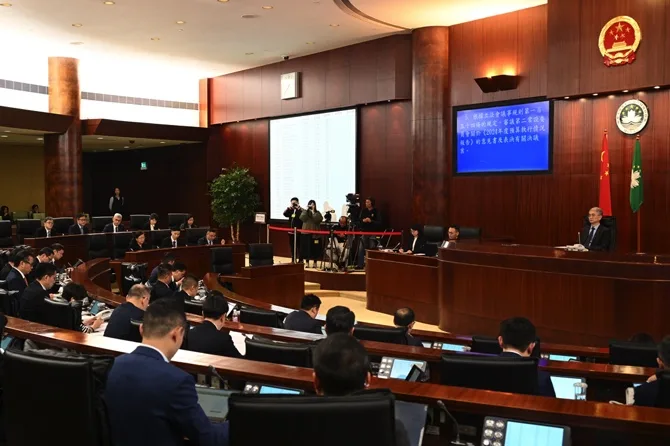
The Legislative Assembly (AL) recently passed amendments to improve the mechanism for spoken inquiry sessions, with the new rules taking effect for the first time yesterday.
Under the revised mechanism, follow-up remarks by the inquiring lawmaker and other lawmakers during Q&A sessions are consolidated into a single segment.
Concurrently, the government’s response time has been reduced from three to two minutes, with all questions addressed in a single session. Additionally, all lawmakers co-signing inquiries are now permitted to participate in follow-up questioning immediately after the government’s response.
The time limit for legislators to read out their questions remains at a maximum of five minutes per session, while the government’s response time stays at 10 minutes. Each co-signing lawmaker has the right to seek clarification regarding the government’s response, and other members may also request clarification immediately thereafter.
Lawmakers’ remarks are limited to no more than three minutes, followed by the government’s reply, with a total of 15 minutes allocated for the government’s response.
Despite the previous discussion and approval of the new mechanism, during the initial implementation, AL’s president, André Cheong, reminded some lawmakers to stick to the rules during follow-up questioning.
He emphasized that follow-up questions should focus on specific aspects of the government representatives’ response that require further clarification, stating that legislators “need to do their homework and look at those points.”
The session in question featured an inquiry from lawmaker Chan Hao Weng, with the Secretary for Social Affairs and Culture, O Lam, responding to an inquiry on the Collaborative Development of Higher Education Institutions in the Macau-Hengqin International Education (University) Town.
The topic centered on the construction and development of higher education institutions for students from Macau and international students. In accordance with the requirements of the legislative resolution, Cheong noted that the question was unacceptable and added that the Secretary had the right to “choose not to answer.”